It all starts with a damp patch. You ignore it, it gets bigger, and the smell gets worse. Suddenly, you are standing in your basement with a torch, trying to figure out where the water is coming from.
You go to the web to search for solutions, and two names keep appearing: Drylok and Flex Seal, and you wonder which one can stop the moisture, which one can protect your walls, and which one won’t need to be reapplied every 6 months.
This guide gives a straight, honest answer about which one you should choose based on what the product actually does or is built to do, not what’s written on the packaging.
What is Drylok?
is masonry waterproofing that works by penetrating deep into the pores of concrete, brick, and cinder block walls, bonding with the material itself rather than sitting on top of it.
How does it work?
Once applied, it forms a thick, waterproof, rigid barrier that physically blocks moisture from pushing through the wall from the outside.
Where should you use Drylok?
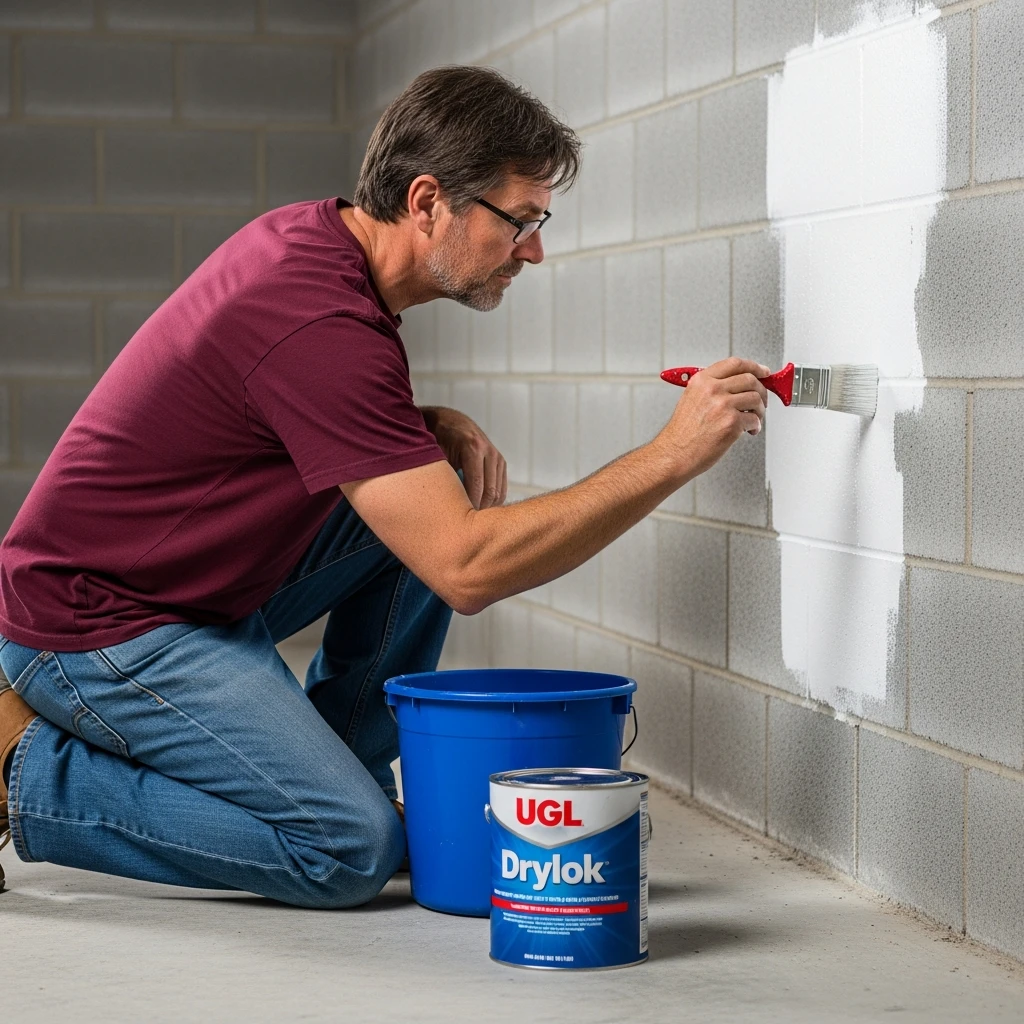
It was specifically engineered for low-grade surfaces such as basements, foundation walls, and retaining walls, where moisture pressure builds over time and pushes against the wall from the soil side. Drylok has the capacity to withstand 15 PSI of hydrostatic pressure on its extreme line, which is equivalent to a column of water 33 feet tall pressing against your wall. Most of our residential buildings face 2-5 PSI during rain. Hence, Drylok carries a good safety margin for your house.
It works as a waterproof primer, so you can paint over it once dry.
Drylok Product Range
Drylok Original Entry-level: product formula is best used against basic moisture protection and minor seepage on concrete and masonry. Mostly chosen for walls with less moisture exposure.
Extereme : The heavy duty version. Thicker formula, stronger adhesion, rated to 15 PSI hydrostatic pressure. The line most professionals reach for when standard versions have previously failed on a wall.
Drylok Floor and Wall: Siloxane-based rather than latex. Penetrates concrete slightly and still creates a barrier to stop moisture. Considered better for exterior applications because it handles freeze-thaw cycles without cracking.
What is Flex Seal?
Flex Seal is a rubberized liquid coating that forms a flexible waterproof membrane on the surface of whatever it is applied to.
How does FlexSeal work?
Flex Seal sits on the surface and packs the cracks, gaps, and holes with a rubbery layer.
Where should you use FlexSeal?
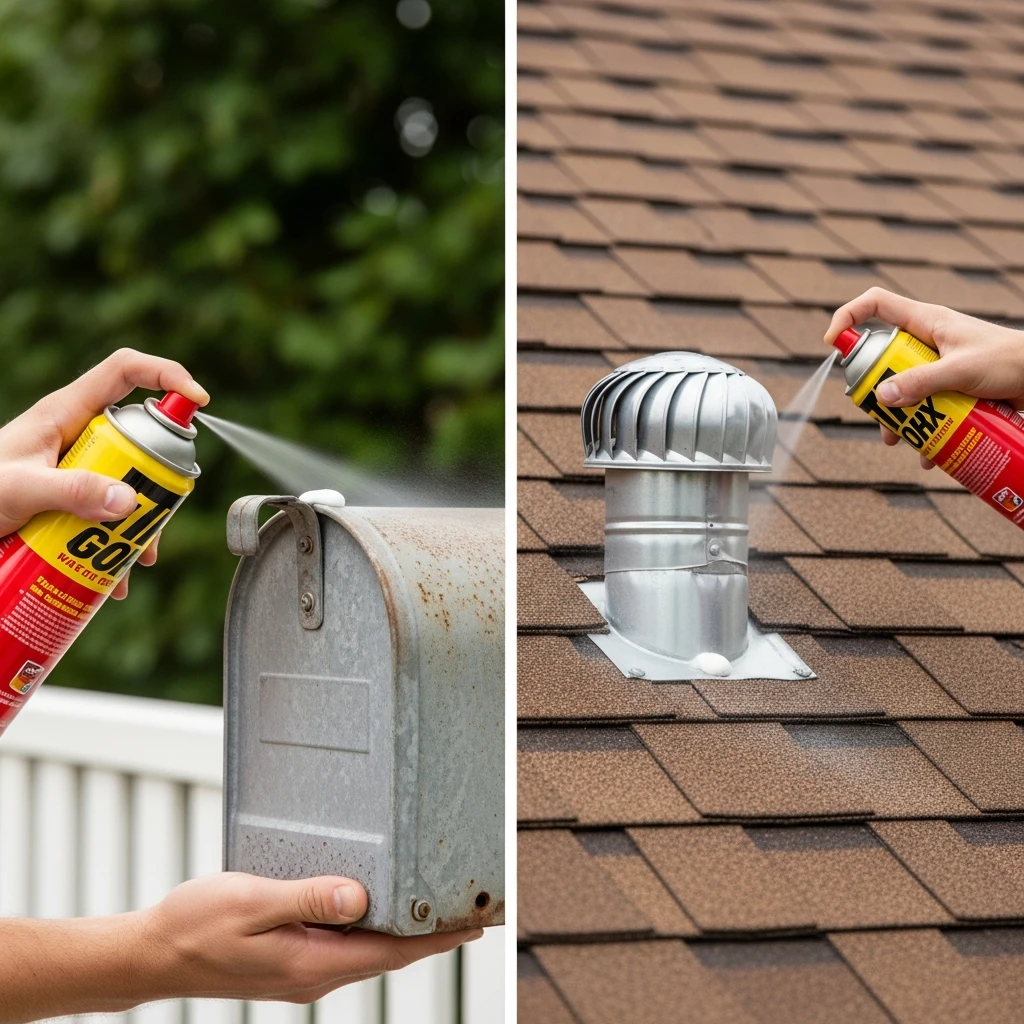
The main point that sets it apart is its flexibility. It is flexible, hence good for surfaces that contract or vibrate, such as gutters, roofs, pipes, and joints.
This is a multi-surface solution as it can stick to metal, wood, plastic, concrete, rubber, and even fabric in some applications.
Flex Seal Product Range
Flex Seal Liquid – The liquid is poured or brushed on the surface and creates a thick rubber coating that fills cracks and seals gaps.
Flex Seal Spray – The Same formula in an aerosol form. Easier for hard-to-reach areas, thin coats and quick applications. Is considered less precise for targeted crack filling.
Flex Seal Tape – Self-fusing rubber tape for instant waterproofing of pipes, joints and seams. It has no drying time and directly bonds on contact.
Flex Glue – A thick adhesive used for bonding surfaces while sealing moisture.
Flex Shot – A rubber caulking product for sealing around tubs, sinks, windows, and doors.
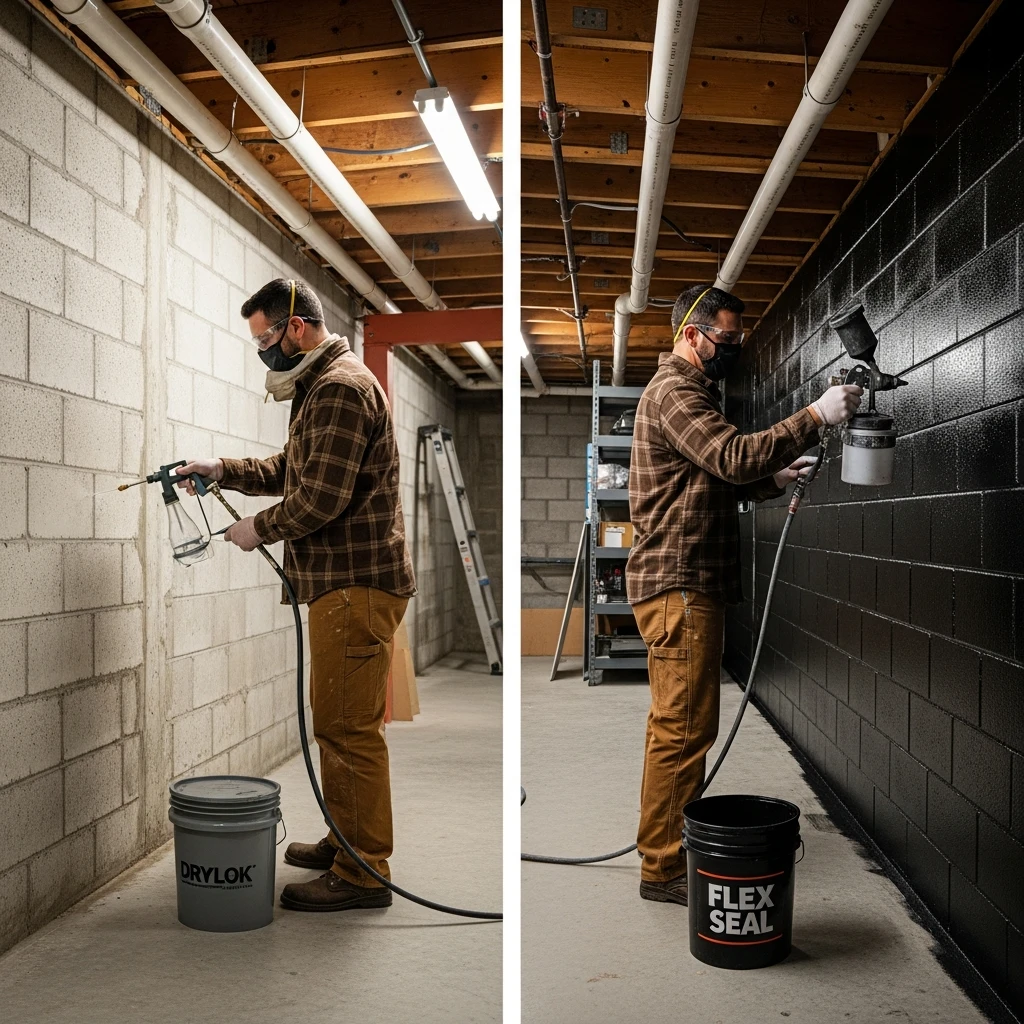
Drylok vs FlexSeal: Key Differences
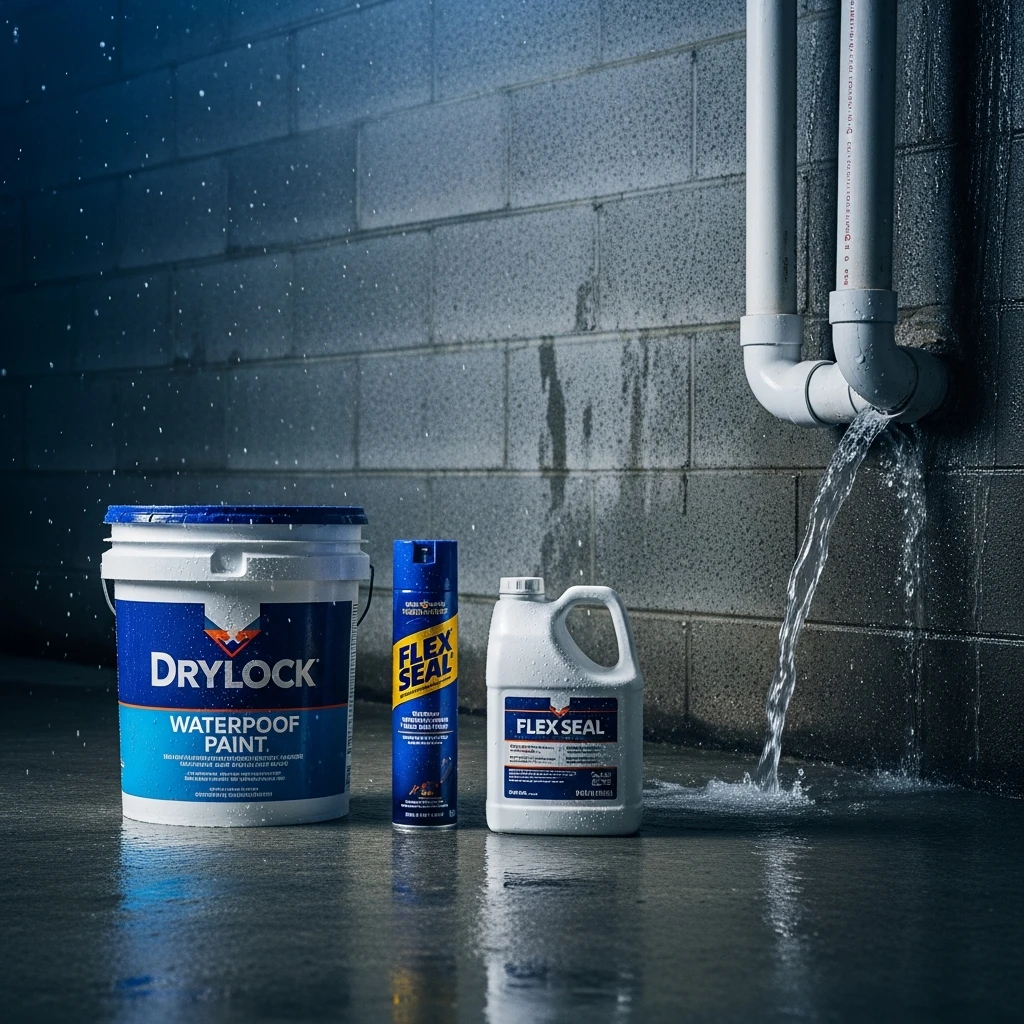
Purpose
Drylok Purpose
Drylok’s sole purpose is long-term waterproofing of masonry surfaces from the inside out. It is designed for surfaces that sustain more hydrostatic pressure and moisture exposure over the decades.
FlexSeal Purpose
Flex Seal’s purpose is broader and more immediate. It seals the visible cracks, holes, and gaps across a wide variety of surfaces.
Surface Compatibility
Where does Drylok work best?
Drylok can be used only on surfaces such as concrete, stucco, brick, cinder block, and masonry, not on wood, metal, plastic, or glass. The formula Drylok uses specifically requires a porous surface to penetrate and bond to. Going against its nature by applying it to a nonporous surface results in poor adhesion and eventual peeling.
Where does FlexSeal work best?
FlexSeal is flexible and can be applied to multiple surfaces, including metal, wood, plastic, concrete, rubber, and fabric. Porosity does not matter with FlexSeal as it sits right on top of any surface it is applied to. This makes it a versatile product.
How does each product stop water?
This is a major difference that people should not overlook. Drylok penetrates the concrete itself; it does not just coat the surface but fills all the internal pores and capillary pathways that water might use to travel. The waterproofing happens inside the material, not just on the surface.
FlexSeal waterproofs the surface by creating a rubber membrane on top that blocks visible water entry points. If water is already inside the surface and pushing through, then FlexSeal can’t stop it. The pressure will eventually push through or around the rubber coating.
This is why Drylok handles sustained moisture pressure in basements, and FlexSeal does not. The depth of protection between the two is very different.
Durability
Drylok Durability
DryLok Original can last from 5 to 10 years, but DryLok Extreme can last even longer under sustained moisture conditions. Because it bonds with the masonry itself and it does not peel or flake under normal conditions.
FlexSeal Durability
FlexSeal is moderately durable but requires reapplication more frequently than Drylok, particularly in high-moisture environments where the rubber coating is under sustained water pressure.
Which lasts longer?
Drylok drying time
Drylok takes 2 to 3 hours to dry between coats and a full 24 hours or more to cure properly. The thick formula bonds slowly.
FlexSeal drying time
FlexSeal dries to the touch within 2-3 hours and fully cures in 24-48 hours, depending on the product type and application thickness. Because it is applied in thinner layers than Drylok, it dries faster.
Which offers better value?
Drylok Cost
Drylok per gallon covers 75-100 sq. ft per gallon for one coat. A gallon costs around $20- $ 30, making it cost-effective for large surface areas.
FlexSeal Cost
FlexSeal is sold in small containers such as spray cans and quart or gallon liquid formats. On a per-square-foot basis, it is considerably more expensive than Drylok for large areas. It is economical for small targeted repairs but becomes costly when covering large surface areas.
Is Drylok better than FlexSeal?
Neither product is universally better; they were built for totally different jobs, and the answer depends not on the product, but on the surface you are using it on.
If you choose drylok
For basement walls, foundations, and any below-grade masonry that deals with sustained moisture pressure, Drylok is the better choice.
If you choose FlexSeal
The requirement is for gutters, pipes, roof repairs, cracks, and non-masonry surfaces. In any situation, a flexible rubber seal is needed on multiple surface types.FlexSeal is the better product.
Drylok vs FlaxSeal: Which is better for basement walls?
For basement walls, Drylok is the clear choice. Basement is driven by hydrostatic pressure from water-saturated soil pushing against the exterior of the wall and forcing moisture through concrete pores from the outside in. Drylok penetrates those pores and seals from within, creating a barrier that pressure cannot push past.
FlexSeal sits on the surface and can cover the visible cracks, but eventually the hydrostatic pressure behind it will push through the rubber coating. Hence, Drylok is a more effective and reasonable choice for the basement.
What are the disadvantages of Drylok?
Drylok doesn’t fix the root cause of the problem; it just treats the symptoms inside while the actual cause keeps pushing from the outside.
Limitations of Drylok
- It cannot be applied to paint, sealers, or dirty surfaces. The wall must be stripped, cleaned, and left bare before it is applied.
- It dries rigid, which means any movement or expansion over time can crack the coating.
- It is masonry-only, meaning it can only be used on surfaces like concrete, brick, and cinderblock, so it has no use outside that specific surface category.
Where should you not use FlexSeal?
- Never use FlexSeal under surfaces experiencing sustained pressure, such as basement walls where soil-side moisture is pushing through, as this will eventually defeat the rubber coating.
- Avoid using it on foam materials as the formula can warp or dissolve certain foam types on contact.
- It should also not be used in high-heat environments such as engine components, radiators, or gas lines, as rubber coating is not advised for such high temperatures.
Conclusion
Choosing between the two is not about finding the right product; it is about finding the product that best matches the problem you are trying to solve.For certain surfaces, Drylok is a better long-term solution. It is engineered specifically for masonry surfaces and designed to withstand hydrostatic pressure, making it an ideal choice for below-grade waterproofing.
On the other hand, FlexSeal stands out where flexibility matters. It adheres to a wide range of materials and is ideal for sealing roof leaks, gutter pipes, RVs, windows, and other areas where surfaces can expand, vibrate, or contract over time.
Hence, these products are not direct competitors; they solve different problems. Understanding the issue, whether it is water pressure inside masonry or simply sealing a surface crack, will help you choose the right product the first time and avoid unnecessary repairs later.
Frequently Asked Questions
Can I apply FlexSeal over Drylok?
It is generally not recommended. Drylok forms a painted masonry coating, and applying FlexSeal over it may result in poor adhesion.
Can Drylok stop active water leaks?
Drylok is designed in a way to stop hydrostatic pressure and resist moisture, but it cannot seal large, actively flowing cracks.
How long does Drylok last?
When applied properly, Drylok original is expected to last between 5-10 years, whereas Drylok Extreme is expected to last even longer, depending on moisture conditions and maintenance.
How long does FlexSeal last?
FlexSeal can be expected to last several years under normal conditions, but its lifespan depends on several factors, including sunlight exposure, temperature fluctuations, and the surface.
Which product is more cost-effective?
For large masonry surfaces, Drylok is a more cost-effective choice. FlexSeal is a better choice for small repairs, such as spot sealing, and for projects involving multiple surfaces.
Which product should a homeowner choose?
If your project involves concrete, brick, cinder block, or any masonry surface, then you should go for Drylok, and if you are dealing with small cracks around the roof, pipes, gutters, windows, or other non-masonry surfaces, then FlexSeal is the right choice.